Beyond the Screen: The Unstoppable Evolution of Entertainment Content and Popular Media
The late 20th century introduced fragmentation via cable television and the VCR, allowing niche interests (e.g., 24-hour news, music television, sports networks) to flourish. However, the true rupture occurred with the rise of Web 2.0 and streaming platforms (Netflix, YouTube, TikTok) in the 2010s. As Jenner (2018) notes, streaming decoupled content from a fixed schedule and location, granting the viewer unprecedented agency. Simultaneously, algorithmic recommendation engines replaced human gatekeepers (editors, DJs, programmers), shifting control from cultural institutions to computational models.
Jenkins, H. (2006). Convergence culture: Where old and new media collide . NYU Press.
entertainment content
Ironically, the exhaustion caused by fast media has led to a counter-trend. "Slow TV" (train journeys, fireplace crackles, lo-fi study beats) has exploded. Additionally, podcasts like The Rest Is History and long-form interviews (Lex Fridman, Joe Rogan) command audiences that crave depth over speed. This bifurcation suggests that the future of is not "either/or," but "both/and."
Are you watching, or are you being watched?
The Return of "Slow Media" as Rebellion
Marketing in the Meme Age: How Content Goes Viral
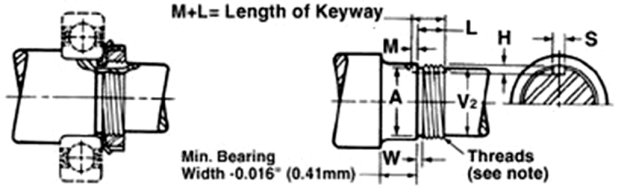
External Lock Nut Threads per ABMA 8.2
Xxxxnl Videos Best File
Beyond the Screen: The Unstoppable Evolution of Entertainment Content and Popular Media
The late 20th century introduced fragmentation via cable television and the VCR, allowing niche interests (e.g., 24-hour news, music television, sports networks) to flourish. However, the true rupture occurred with the rise of Web 2.0 and streaming platforms (Netflix, YouTube, TikTok) in the 2010s. As Jenner (2018) notes, streaming decoupled content from a fixed schedule and location, granting the viewer unprecedented agency. Simultaneously, algorithmic recommendation engines replaced human gatekeepers (editors, DJs, programmers), shifting control from cultural institutions to computational models.
Jenkins, H. (2006). Convergence culture: Where old and new media collide . NYU Press. xxxxnl videos best
entertainment content
Ironically, the exhaustion caused by fast media has led to a counter-trend. "Slow TV" (train journeys, fireplace crackles, lo-fi study beats) has exploded. Additionally, podcasts like The Rest Is History and long-form interviews (Lex Fridman, Joe Rogan) command audiences that crave depth over speed. This bifurcation suggests that the future of is not "either/or," but "both/and." Convergence culture: Where old and new media collide
Disclaimer
This data is provided for general information only. The intention is to provide accurate information; regardless; errors may exist in the supplied information. If accuracy is critical, base your final decisions on the data provided in the root document; which is a copyrighted document. To purchase a copy visit an Authorized Reseller.
Comments
Original Posting: 3/2/2011
Last Revision: 3/23/2018
Error corrections in, or comments about, the above data can be sent to:
Gage Crib Worldwide, Inc.
6701 Old 28th St SE, Suite B
Grand Rapids, MI 49546-6937
Phone: 001-616-954-6581 • Fax: 001-616-954-6583 CONTACT FORMS & INFO