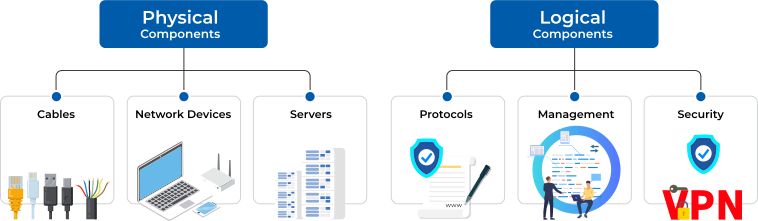
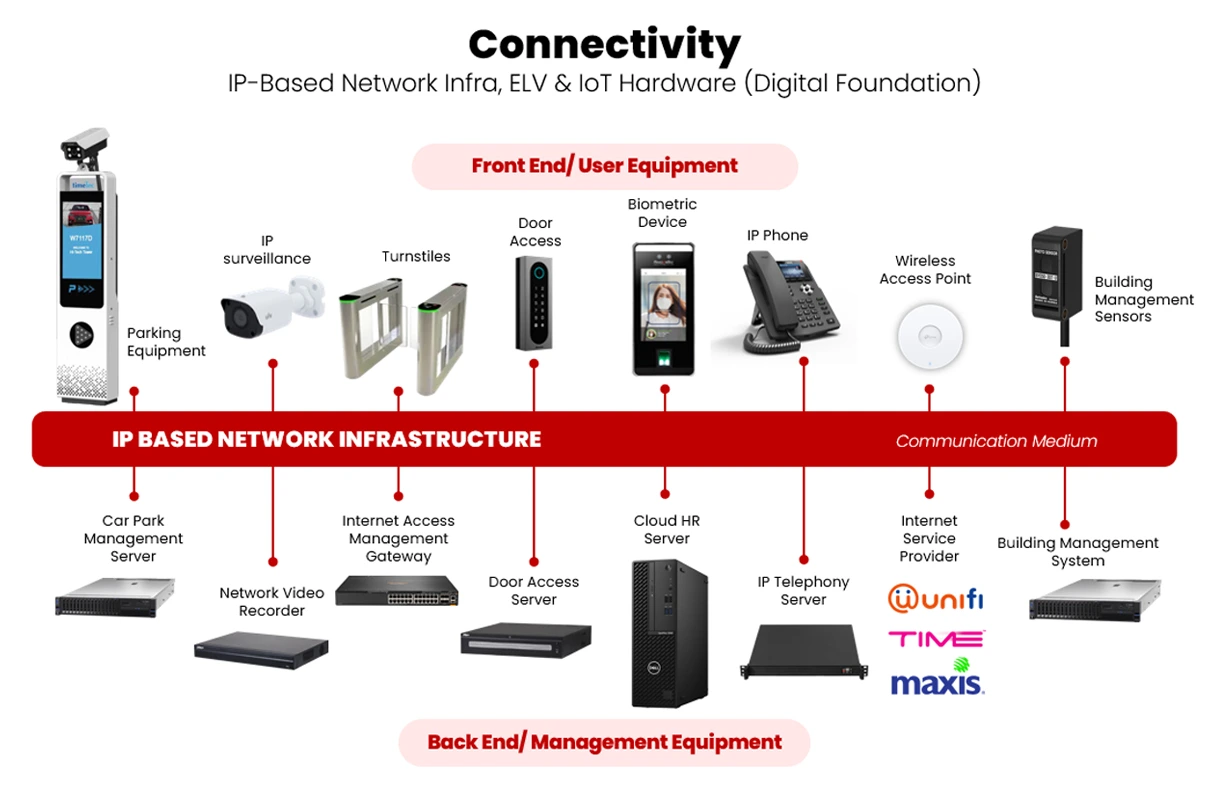
TimeTec offers complete Network Infrastructure solutions alongside our comprehensive PropTech ecosystem, delivering seamless connectivity to support smart building operations. From structured cabling to high-performance network equipment, our infrastructure services are designed to integrate flawlessly with TimeTec’s PropTech solutions—including smart access and elevator control, ELV & IoT automation, smart cashless and touchless parking, visitor management and etc., ensuring a reliable, scalable, and future-ready environment for modern commercial and residential buildings.
What Is a Well-Designed Network Infrastructure?
A well-designed network infrastructure is essential for any organization that relies on technology to operate effectively. It provides the foundation for integrating emerging technologies and new applications, allowing businesses to remain agile, up-to-date, and competitive in their industries.
For service providers, building a robust network infrastructure means ensuring scalability, high availability, and intelligent load balancing. These elements are critical to maintaining seamless connectivity and reliable system performance—key factors in today’s fast-paced digital environment.
Since network interruptions can never be entirely avoided, it's also vital to adopt streamlined network architectures and automated management tools. These help network administrators quickly identify, isolate, and resolve issues, minimizing downtime and ensuring optimal network functionality.
Reasoning Book with Piyush Varshney (Edition 01)
The , published by PV Publication in early 2021, is a specialized study guide designed to help students master verbal and non-verbal reasoning for competitive exams. Authored by Piyush Varshney , a veteran educator with over 10 years of experience, the book is built on the "solve without pen and paper" philosophy, emphasizing mental shortcuts and conceptual clarity. Core Structure and Content
The Man Behind the Book
SSC, Banking, Railways, CSAT (UPSC), and Police exams
Reasoning Book with Piyush Varshney " is designed as a complete guide for aspirants preparing for competitive government exams like . Author Piyush Varshney created this resource to help students build crystal-clear concepts and master the art of solving complex reasoning problems efficiently, often without using a pen and paper . Core Features of the Book
- Practical and exam-oriented; useful for bank, SSC, railway, and other objective exams.
- Compact and starter-friendly—good for self-study and revision.
- Emphasizes shortcuts that save time under exam pressure.
Reasoning Book With Piyush Varshney Edition- 01 May 2026
Reasoning Book with Piyush Varshney (Edition 01)
The , published by PV Publication in early 2021, is a specialized study guide designed to help students master verbal and non-verbal reasoning for competitive exams. Authored by Piyush Varshney , a veteran educator with over 10 years of experience, the book is built on the "solve without pen and paper" philosophy, emphasizing mental shortcuts and conceptual clarity. Core Structure and Content
The Man Behind the Book
SSC, Banking, Railways, CSAT (UPSC), and Police exams
Reasoning Book with Piyush Varshney " is designed as a complete guide for aspirants preparing for competitive government exams like . Author Piyush Varshney created this resource to help students build crystal-clear concepts and master the art of solving complex reasoning problems efficiently, often without using a pen and paper . Core Features of the Book
- Practical and exam-oriented; useful for bank, SSC, railway, and other objective exams.
- Compact and starter-friendly—good for self-study and revision.
- Emphasizes shortcuts that save time under exam pressure.